The workshop presentations should be given IN PERSON, and in some specific cases ON ZOOM if the in-person participation is not possible.
This event is a part of the CFNS workshop / ad-hoc meeting series. See the CFNS CONFERENCES AND WORKSHOPS webpage for other events.
Note: The remote Zoom link is only visible to the registered participants. After registration, the Zoom link will appear on the menu bar.
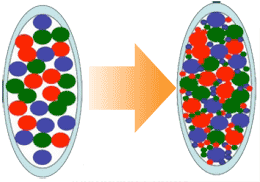
Description: The exploration of gluon saturation represents one of the central scientific pillars of the entire program at the Electron-Ion Collider. It is widely acknowledged that gluon saturation effects are likely to manifest in high-energy electron-nucleus deep-inelastic scattering, building upon important discoveries made at the HERA, RHIC, and the LHC. To investigate the saturation phenomenon, one must identify observables whose behavior dramatically differs in the presence versus absence of saturation effects. A particularly promising channel is diffractive vector meson production in electron-nucleus collisions. Since the leading-order perturbative QCD cross section for hard diffraction scales with the square of the gluon density, this process is expected to be highly sensitive to gluon saturation at small Bjorken-$x$. Vector mesons could thus serve as some of the most effective probes of small-$x$ gluon dynamics in nuclei. Other related processes -- such as inclusive and exclusive diffraction, plus multihadron production -- are also essential for understanding the onset and characteristics of gluon saturation.
In order to ensure a productive and impactful meeting, we plan to invite leading theorists and key experimentalists, including those from the SURGE/CTEQ Collaborations and ePIC Collaboration, respectively.
Objectives: The workshop will focus on
a) critical re-assessment of the feasibility and scientific impact of saturation-sensitive measurements at the EIC to be guided by the capabilities and limitations of the ePIC detector (and the potential second detector), alongside recent theoretical developments in CGC-based and small-$x$ QCD frameworks, as well as discussing available simulation tools.
b) making of a summary report consolidating both theoretical insights and simulation-driven studies, aimed at strengthening the physics case and experimental readiness for those crucial EIC measurements.
Topics to be discussed: Topics under consideration will in particular include the reconstruction of vector mesons, real photons (DVCS), and multihadron final states; considering aspects of tracking, particle identification, electromagnetic and hadronic calorimetry, DAQ and readout systems, as well as the integration of forward and backward detector components with the central detector. But in a broader sense, the workshop will focus on discussing
(i) current experimental and theoretical challenges in exclusive/inclusive diffraction at the EIC;
(ii) capabilities of ePIC for coherent/incoherent vector meson, DVCS and multihadron reconstructions;
(iii) high gluon density regime of QCD;
(iv) precision CGC studies including global analyses;
(v) Monte-Carlo pseudo-data generation, detector simulations, and physics impact studies.
This workshop is hosted at and supported by

Conference information
Registration
Registration for this event is currently open.