Gluon Saturation, Diffraction and Multihadron Production at the EIC: Theory, Simulations and Feasibility of Measurements

America/New_York
CFNS, C 120: Peter Paul Seminar Room, Physics Building (Stony Brook University)

CFNS, C 120: Peter Paul Seminar Room, Physics Building

Stony Brook University

Description

The workshop presentations should be given IN PERSON, and in some specific cases ON ZOOM if the in-person participation is not possible.

This event is a part of the CFNS workshop / ad-hoc meeting series. See the CFNS CONFERENCES AND WORKSHOPS webpage for other events.

Note: The remote Zoom link is only visible to the registered participants. After registration, the Zoom link will appear on the menu bar.

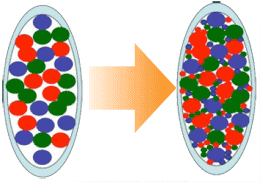
Description:  The exploration of gluon saturation represents one of the central scientific pillars of the entire program at the Electron-Ion Collider. It is widely acknowledged that gluon saturation effects are likely to manifest in high-energy electron-nucleus deep-inelastic scattering, building upon important discoveries made at the HERA, RHIC, and the LHC. To investigate the saturation phenomenon, one must identify observables whose behavior dramatically differs in the presence versus absence of saturation effects. A particularly promising channel is diffractive vector meson production in electron-nucleus collisions. Since the leading-order perturbative QCD cross section for hard diffraction scales with the square of the gluon density, this process is expected to be highly sensitive to gluon saturation at small Bjorken-$x$. Vector mesons could thus serve as some of the most effective probes of small-$x$ gluon dynamics in nuclei. Other related processes -- such as inclusive and exclusive diffraction, plus multihadron production -- are also essential for understanding the onset and characteristics of gluon saturation.
    In order to ensure a productive and impactful meeting, we plan to invite leading theorists and key experimentalists, including those from the SURGE/CTEQ Collaborations and ePIC Collaboration, respectively.

Objectives:  The workshop will focus on
  a) critical re-assessment of the feasibility and scientific impact of saturation-sensitive measurements at the EIC to be guided by the capabilities and limitations of the ePIC detector (and the potential second detector), alongside recent theoretical developments in CGC-based and small-$x$ QCD frameworks, as well as discussing available simulation tools.
  b) making of a summary report consolidating both theoretical insights and simulation-driven studies, aimed at strengthening the physics case and experimental readiness for those crucial EIC measurements.

Topics to be discussed:  Topics under consideration will in particular include the reconstruction of vector mesons, real photons (DVCS), and multihadron final states; considering aspects of tracking, particle identification, electromagnetic and hadronic calorimetry, DAQ and readout systems, as well as the integration of forward and backward detector components with the central detector. But in a broader sense, the workshop will focus on discussing
   (i) current experimental and theoretical challenges in exclusive/inclusive diffraction at the EIC; 
   (ii) capabilities of ePIC for coherent/incoherent vector meson, DVCS and multihadron reconstructions; 
   (iii) high gluon density regime of QCD; 
   (iv) precision CGC studies including global analyses;
   (v) Monte-Carlo pseudo-data generation, detector simulations, and physics impact studies.


This workshop is hosted at and supported by

Registration
Registration for the meeting
Participants
    • 9:00 AM 5:00 PM
      Tuesday
      • 9:00 AM
        Opening remarks 10m
        Speaker: Organizers
      • 9:10 AM
        Can we discover the Odderon(s) at the EIC ? 40m
        Speaker: Adrian Dumitru
      • 9:50 AM
        Coffee break 25m
      • 10:15 AM
        Diffractive electro- and photo-production of vector mesons in exclusive processes using CGC 40m
        Speaker: Bheemsehan Gurjar
      • 10:55 AM
        Coherent DVCS from polarized nuclei at the EIC 40m
        Speaker: Jackson Pybus
      • 11:35 AM
        Discussion session I 25m
      • 12:00 PM
        Lunch 1h 30m
      • 1:30 PM
        TBD 40m
        Speaker: Feng Yuan
      • 2:10 PM
        Probing dense nuclear matter at small x 40m
        Speaker: Fredrick Olness
      • 2:50 PM
        Coffee break 25m
      • 3:15 PM
        Rotating the CGC: Paving the way for precision computations 40m
        Speaker: Yacine Mehtar-Tani
      • 3:55 PM
        Simultaneous fit for CGC inclusive DIS and single hadron inclusive production cross sections 40m
        Speaker: Piotr Korcyl
      • 4:35 PM
        Discussion session II 25m
    • 9:00 AM 9:00 PM
      Wednesday
      • 9:00 AM
        Searching for non-linear QCD evolution: A new approach 40m
        Speaker: Peter Jacobs
      • 9:40 AM
        Probing gluon saturation via diffractive jets 40m
        Speaker: Edmond Iancu
      • 10:20 AM
        Coffee break 25m
      • 10:45 AM
        Probing gluon saturation at the future EIC 40m
        Speaker: Gabriel Garcia
      • 11:25 AM
        Discussion session I 25m
      • 11:50 AM
        Lunch 1h 40m
      • 1:30 PM
        Small-x physics in DIS: An overview and recent developments 40m
        Speaker: José Garrido
      • 2:10 PM
        Aspects of particle production in the CGC formalism (Ríchard Terra) 40m
        Speaker: Ríchard Terra
      • 2:50 PM
        Coffee break 25m
      • 3:15 PM
        Probing small-x dynamics in proton–nucleus collisions at STAR 40m
        Speaker: Dener De Souza Lemos
      • 3:55 PM
        Low-x physics in di-hadron correlations from ep, eA, pp, and pA collisions 40m
        Speaker: Xiaoxuan Chu
      • 4:35 PM
        Discussion session II 25m
      • 6:30 PM
        Workshop dinner 2h 30m
    • 9:00 AM 6:40 PM
      Thursday
      • 9:00 AM
        DIS dijet production and the search for saturation at the EIC 40m
        Speaker: Andrey Tarasov
      • 9:40 AM
        ITMD at arbitrary x: Dijet production in DIS 40m
        Speaker: Shaswat Tiwari
      • 10:20 AM
        Coffee break 25m
      • 10:45 AM
        Feasibility of extracting the OAM distributions at the EIC through elastic dijet and dihadron production 40m
        Speaker: Brandon Manley
      • 11:25 AM
        Discussion session I 25m
      • 11:50 AM
        Lunch 1h 40m
      • 1:30 PM
        High-energy evolution in planar QCD to three loops: the non-conformal contribution 40m
        Speaker: Mathieu Giroux
      • 2:10 PM
        Beyond Wick contractions: Disconnected diagrams and hadron structure at low x 40m
        Speaker: Simonetta Liuti
      • 2:50 PM
        Coffee break 25m
      • 3:15 PM
        T-Odd Weizsacker-Williams TMDs at small x 40m
        Speaker: M. Gabriel Santiago
      • 3:55 PM
        Moving beyond a single best fit: Bayesian likelihood analysis of chiral-odd Compton form factors 40m
        Speaker: Saraswati Pandey
      • 4:35 PM
        Discussion session II 25m
    • 9:00 AM 11:50 AM
      Friday
      • 9:00 AM
        Parton distributions in the shockwave formalism 40m
        Speaker: Diego Padilla
      • 9:40 AM
        Recent results on entropy production in DIS 40m
        Speaker: Krzysztof Kutak
      • 10:20 AM
        Coffee break 25m
      • 10:45 AM
        Centrality in eA collisions using BeAGLE++ 40m
        Speaker: Arjun Kumar
      • 11:25 AM
        Discussion session 25m