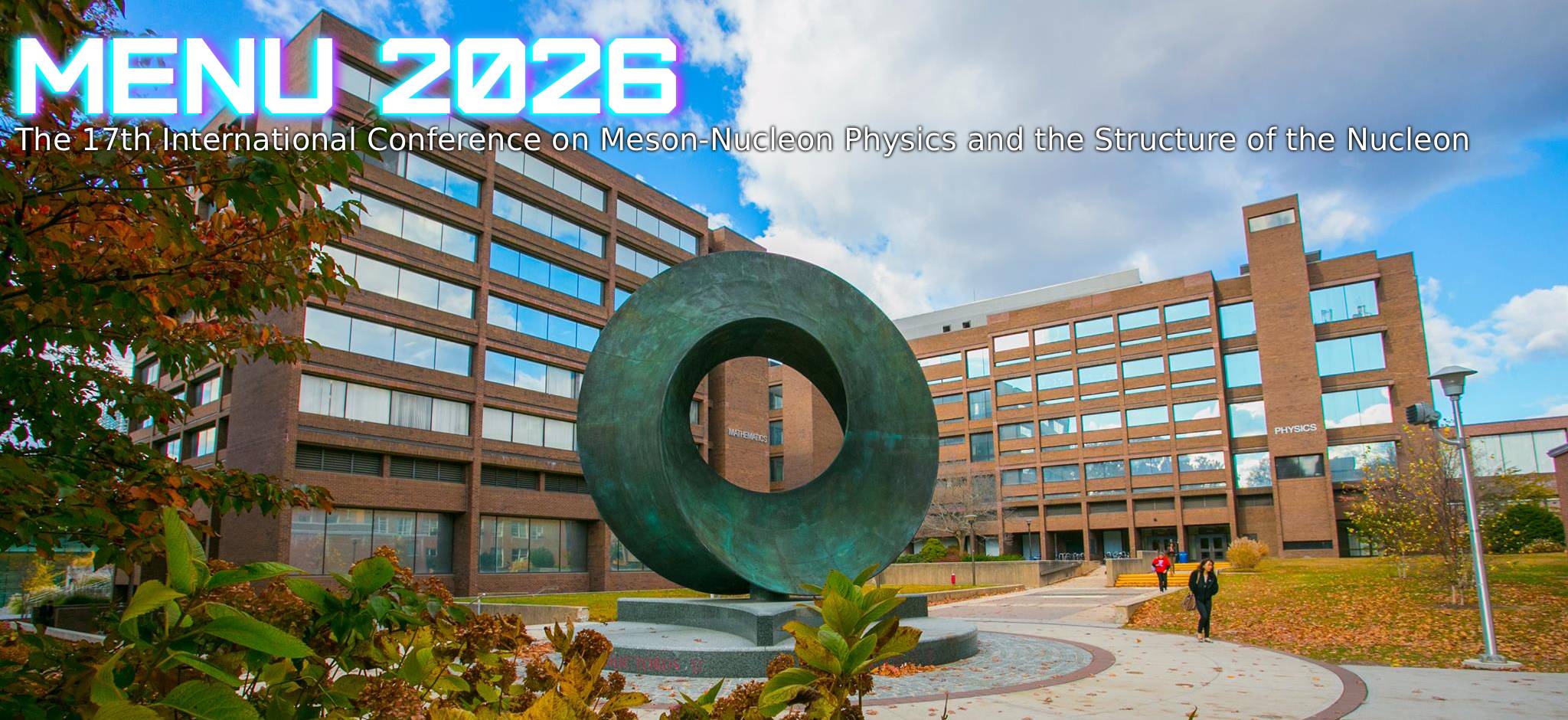
MENU 2026

→ America/New_York
Wang Center

Wang Center

Description


MENU 2026 - The 17th International Conference on Meson-Nucleon Physics and the Structure of the Nucleon

The 17th edition of the "International Conference on Meson-Nucleon Physics and the Structure of the Nucleon" (MENU 2026) is organized by the Center for Frontiers in Nuclear Physics and the Physics and Astronomy Department of Stony Brook University. It will be held at the Charles B. Wang Center.

Scam warning:

Please be aware of potential scams claiming to make housing reservations on your behalf. We were made aware of some participants receiving such messages from "booking@gtravelexpert.co" or similar addresses. Please ignore such emails and do not reply, click shared links, or provide your credit card information. 

Registration
Pre-Registration Form
    • 8:45 AM → 9:00 AM
      Welcome 15m
    • 9:00 AM → 10:30 AM
      Plenary I
      • 9:00 AM
        ePIC experimental overview 45m

        The Electron-Ion Collider (EIC) is designed to explore the three-dimensional structure of nucleons and nuclei with unprecedented precision through polarized ep and eA collisions over a wide range of energies. To fulfill this scientific mission, the ePIC experiment is being developed as a general-purpose and high-performance detector system, integrating state-of-the-art tracking, calorimetry, particle identification, and forward/tagging subsystems. This presentation will provide an overview of the current status for the ePIC detector. In addition, recent advancements in simulation and performance studies, along with their impacts on refining our understanding of nucleon and nuclear structure, will be highlighted.

        Speaker: Rongrong Ma (BNL)
      • 9:45 AM
        EIC theory overview 45m

        The Electron-Ion Collider is a next-generation QCD machine dedicated to the understanding of nucleon and nuclear structure. I will give a theoretical overview of the main physics cases for the EIC including multi-dimensional tomography, nucleon mass and spin, gluon saturation and the emerging topic of quantum entanglement.

        Speaker: Yoshitaka Hatta (BNL)
    • 10:30 AM → 10:50 AM
      Coffee
    • 10:50 AM → 12:20 PM
      Plenary I
      • 10:50 AM
        Probing the Standard Model and Beyond at MESA 45m

        The Mainz Energy-Recovery Superconducting Accelerator (MESA), to be commissioned in 2027, will enable precision experiments in nuclear, hadron, and particle physics. We report on the physics program of its three fixed-target experiments: (i) MAGIX, (ii) P2, and (iii) DarkMESA. MAGIX exploits MESA's energy-recovery operation to deliver very high beam currents onto a windowless gas-jet target, surrounded by two high-resolution magnetic spectrometers. This unique combination opens up competitive measurements of the proton radius, searches for dark-sector particles, and nuclear-astrophysics reaction studies. The P2 experiment runs in MESA's external-beam mode and measures the parity-violating spin asymmetry, yielding the electroweak mixing angle at low momentum transfer. Comparison with the Standard Model prediction probes new physics at scales up to 50 TeV, and additionally constrains the neutron skin of nuclei. Finally, the DarkMESA beam-dump experiment, installed downstream of P2, searches for hypothetical light dark-matter particles.

        Speaker: Achim Denig (University Mainz)
      • 11:35 AM
        Hadron Physics at J-PARC 45m

        The Hadron Experimental Facility (HEF) of Japan Proton Accelerator Research Complex, J-PARC, started its operation in 2009. The most distinguishing feature of J-PARC its high proton intensity, and J-PARC has been improving the proton intensity continuously; HEF achieved 101 kW proton operation in April, 2026. As the proton beam intensity has been increased, research at the HEF has evolved from experiments using pion beams to the current full-scale execution of experiments utilizing kaon beams. This presentation provides an overview of the experiments conducted at the HEF to date and discusses future prospects.

        Speaker: Shinya Sawada
    • 12:20 PM → 1:40 PM
      Lunch
    • 1:40 PM → 3:10 PM
      Plenary II
      • 1:40 PM
        Theoretical Hadron Spectroscopy as a Probe of QCD 45m

        Accessing the hadron spectrum from Quantum Chromodynamics (QCD) poses several challenges due to its nonperturbative nature and the fact that many states couple strongly to multi-particle decay channels. Recent advances in theoretical formalisms and numerical algorithms have made it possible to study few-hadron systems directly from QCD. A synergistic approach combining lattice QCD with scattering theory provides a systematic pathway to determine hadron spectra and scattering amplitudes from first principles. In this talk, I will present an overview of this program, with an emphasis on recent developments in three-body dynamics and electroweak matrix elements of few-body systems. These techniques are pushing the boundaries of resolving the few-body problem in hadron spectroscopy from first principles.

        Speaker: Andrew Jackura
      • 2:25 PM
        Update on Hadron Spectroscopy in LHCb 45m

        Significant progress in studies of hadron spectroscopy has been accomplished by the LHCb experiment, highlighted by its discovery of 76 new conventional and exotic hadrons. This is thanks to its excellent mass resolution and unique capabilities in hadron identification and triggering on heavy flavor events. Recent LHCb results in conventional and exotic hadron spectroscopy will be reviewed.

        Speaker: Hangyi Wu (Syracuse University)
    • 3:10 PM → 3:30 PM
      Coffee
    • 3:30 PM → 5:45 PM
      Plenary II
      • 3:30 PM
        Recent advances in Theory 45m

        TBD

        Speaker: Marc Vanderhaeghen (Johannes Gutenberg-Universität Mainz)
      • 4:15 PM
        Exotic Hadrons at Twenty 45m

        Whether an exotic hadron is elementary or composite is a statement about which fields appear in the effective Lagrangian. The Weinberg criterion has been invoked on the X(3872) to argue for a molecular nature, but it is applied to LHCb data fitted with a Flatté amplitude, which contains an elementary X field: the molecular conclusion is drawn from a fit that assumes the opposite --- and the fit works well.
        We present an alternative parametrization from an auxiliary-field Lagrangian in which the X is dynamically generated, its coupling to the constituent hadrons fixed at the Landau value. It reproduces the deuteron effective range from np scattering with no free parameters. Applied to the X, a good fit at the corresponding Landau coupling is unavoidable if the X is indeed deuteron-like.
        The analogy meets a limit in production. The X is copiously produced at high transverse momentum, where no deuteron is expected, and CMS reports an order-of-magnitude enhancement of prompt X over ψ(2S) in Pb–Pb. Reproducing the observed yields molecularly appears problematic.
        These are symptoms of one fact: the X, like other exotic hadrons, has a compact tetraquark core while looking molecular at large distances. This is the conclusion reached in the Born–Oppenheimer approach.

        Speaker: Antonio Polosa
      • 5:00 PM
        Born-Oppenheimer EFT: an unified description of ordinary and exotic quarkonia 45m

        We show how the Born--Oppenheimer effective field theory (BOEFT)
        provides a unified description of ordinary and exotic quarkonia grounded
        on the non-relativistic expansions of QCD and supplemented with lattice
        QCD inputs. We show applications of the BOEFT to tetraquarks,
        pentaquarks, quarkonium hybrids and to assess threshold effects in the
        quarkonium spectrum. We present the insights that BOEFT delivers us omn
        the mature of these XYZ exotics states.

        Speaker: Nora Brambilla (TUM)
    • 6:00 PM → 8:00 PM
      Reception
    • 9:00 AM → 10:15 AM
      Parallel I
      • 9:00 AM
        Pion-Nucleon Scattering in BChPT combined with 1/Nc Expansion 25m
        Speaker: Dulitha Jayakodige (Hampton University)
      • 9:25 AM
        The $\phi$-Nucleon Interaction and the Possible Existence of Lightest $\phi$-Mesic Nuclei 25m
        Speaker: Roman Kezerashvili (City University of New York)
      • 9:50 AM
        Nucleon Structure with charge correlation at EIC 25m
        Speaker: Haotian Cao (Northwestern University)
    • 9:00 AM → 10:15 AM
      Parallel I
      • 9:00 AM
        Feasibility of pion and kaon structure measurements at the EIC using the Sullivan process 25m
        Speaker: Baptiste Fraisse (The Catholic University of America)
      • 9:25 AM
        L/T Separated Exclusive Meson Cross Sections at High $Q^2$ from Hall C at Jefferson Lab 25m
        Speaker: Chi Kin Tam (CUA)
      • 9:50 AM
        Radiative two-pion amplitude from QCD 25m
        Speaker: Felipe Ortega-Gama (William & Mary)
    • 10:15 AM → 10:40 AM
      Coffee
    • 10:40 AM → 12:20 PM
      Parallel I
      • 10:40 AM
        Nucleon Femtography with NPS Run Group 1a in Jefferson Lab Hall C 25m
        Speaker: Mark Mathison (Ohio University)
      • 11:05 AM
        Neutral-Pion Electroproduction and Hadron Femtography with Jefferson Lab Hall C 25m
        Speaker: Avnish Singh (The Catholic University of America)
      • 11:30 AM
        Simulation study of Deeply Virtual $\pi^0$ Production at the ePIC detector of the EIC 25m
        Speaker: Li Xu (Brookhaven National Laboratory)
      • 11:55 AM
        Constraining Generalized Parton Distributions with Exclusive Lepton-Pair Photoproduction 25m
        Speaker: Yangli Zeng
    • 10:40 AM → 12:20 PM
      Parallel I
      • 10:40 AM
        Vector Meson Nucleon Scattering Length from Omega to Phi to J/Psi to Upsilon Meson 25m
        Speaker: Igor Strakovsky (The George Washington University)
      • 11:05 AM
        Study of Nucleon Resonances in Pion-Induced Reactions at J-PARC E45 25m
        Speaker: Shin Hyung Kim (Kyungpook National University)
      • 11:30 AM
        Multiquark hadrons, hybrids and their mixing with the nucleon 25m
        Speaker: Edward Shuryak (Stony Brook University)
      • 11:55 AM
        Production-dependent interpretation of the KLOE–MAMI discrepancy and its kinematic fingerprints 25m
        Speaker: Yaroslav Balytskyi (Wayne State University)
    • 12:20 PM → 1:45 PM
      Lunch
    • 1:45 PM → 3:25 PM
      Parallel II
      • 1:45 PM
        Unpolarized, helicity and transversity PDF from lattice QCD 25m
        Speaker: Peter Petreczky (BNL)
      • 2:10 PM
        Gravitational form factors and hadron mass decompositions from the three-loop energy-momentum tensor in QCD 25m
        Speaker: Kazuhiro Tanaka (Juntendo University)
      • 2:35 PM
        Hadron Mass and Trace-Anomaly Decompositions from Gradient-Flow-Based Renormalization of the QCD EMT 25m
        Speaker: XIANG Gao
      • 3:00 PM
        Mechanical stresses in two-body systems 25m
        Speaker: Adam Freese (Jefferson Lab)
    • 1:45 PM → 3:25 PM
      Parallel II
      • 1:45 PM
        The MUSE Experiment 25m
        Speaker: Ethan Cline (Stony Brook University)
      • 2:10 PM
        Pion-Proton Scattering in the MUSE Experiment 25m
        Speaker: Kyle Salamone
      • 2:35 PM
        The PRad-II Experiment at Jefferson Lab 25m
        Speaker: Huang Nguyen
      • 3:00 PM
        Two-photon exchange effects in muonic hydrogen 25m
        Speaker: Panagiotis Kalamidas (Johannes Gutenberg-Universität Mainz)
    • 3:25 PM → 3:50 PM
      Coffee
    • 3:50 PM → 5:30 PM
      Parallel II
      • 3:50 PM
        Evidence for Quark Confinement in the Proton 25m
        Speaker: Chen Yang (University of Maryland, College Park)
      • 4:15 PM
        Modeling QCD at Low Resolution: Applications to Hadron Form Factors 25m
        Speaker: Wei-Yang Liu (Stony Brook University)
      • 4:40 PM
        Topological QCD vacuum: hadrons from rest to light front 25m
        Speaker: ismail zahed (Stony Brook University)
    • 3:50 PM → 5:30 PM
      Parallel II
      • 3:50 PM
        A new measurement of the $K^+ \rightarrow \pi^+\nu\bar{\nu}$ branching ratio at the NA62 experiment 25m
        Speaker: Rado Marchevski
      • 4:15 PM
        PHENIX MEASUREMENTS OF IDENTIFIED CHARGED HADRON PRODUCTION IN SMALL AND LARGE SYSTEMS 25m
        Speaker: Chaitanya Prasad (Stony Brook University)
      • 4:40 PM
        Feasibility of Testing Neutrality of Matter Using the Cryogenic Helium Atomic Beam Source Employed in the EIC Absolute Polarimeter 25m
        Speaker: Prajwal MohanMurthy (Massachusetts Institute of Technology)
    • 9:00 AM → 10:30 AM
      Parallel III
      • 9:00 AM
        Multiplicities and spin asymmetries in SIDIS 45m

        Semi-inclusive deep-inelastic scattering (SIDIS) provides a powerful tool to explore the multidimensional structure of the nucleon and the dynamics of hadronization. Measurements of hadron multiplicities and spin-dependent asymmetries offer complementary sensitivity to transverse-momentum-dependent parton distributions and fragmentation functions. This talk will present an overview of recent experimental studies of SIDIS, with emphasis on results from Jefferson Lab, together with complementary measurements from other SIDIS experiments such as COMPASS. Selected measurements of charged- and neutral-hadron multiplicities and spin asymmetries will be discussed, highlighting their multidimensional kinematic dependences and their sensitivity to nucleon structure and fragmentation. Recent experimental and analysis developments, as well as ongoing efforts toward increasingly precise multidimensional SIDIS measurements, will also be highlighted.

        Speaker: Maria Żurek
      • 9:45 AM
        Light Nuclei from Ab Initio Theory 45m

        Ab initio methods that solve the quantum many-nucleon problem with controlled approximations based on validated chiral nucleon-nucleon and three-nucleon forces are currently the best path to achieving a predictive theory of nuclear structure, low-energy scattering and reactions between nuclei. Among them, the ab initio no-core shell model with continuum (NCSMC) is capable of describing bound and unbound states in light nuclei in a unified way. I will review recent applications of NCSMC to few-nucleon systems, structure of halo nuclei, nucleon scattering and radiative capture, and charge exchange and transfer reactions on light nuclei.

        Speaker: Petr Navratil
    • 10:30 AM → 10:50 AM
      Coffee
    • 10:50 AM → 12:20 PM
      Parallel III
      • 10:50 AM
        News from Belle II 45m

        The Belle II experiment at the SuperKEKB asymmetric-energy electron-positron collider provides a clean environment for precision studies of flavor physics and searches for physics
        beyond theStandard Model. In this talk, I will present recent Belle II results, focusing on CP violation, electroweak penguin processes, and semileptonic $B$ decays.
        These measurements provideimportant tests of the Standard Model and help improve our understanding of flavor physics.

        Speaker: Renu Garg
      • 11:35 AM
        Reconstructing hadron structure using AI/ML 45m

        We discuss recent developments in using AI/ML techniques to reconstruct the partonic structure of hadrons. These include the application of normalizing flows to parametric QCD global analysis to improve Bayesian inferences of data resampling, and finite-element methods for PDF and GPD reconstruction using Gaussian processes.

        Speaker: Wally Melnitchouk
    • 12:20 PM → 1:45 PM
      Lunch
    • 1:45 PM → 5:45 PM
      Excursion
    • 6:30 PM → 9:00 PM
      Conference Dinner
    • 9:00 AM → 10:15 AM
      Parallel IV
      • 9:00 AM
        From Inverse Problems to Foundation Models in Hadron Structure 25m
        Speaker: Brandon Kriesten (Argonne National Lab)
      • 9:25 AM
        Variable Rate Neural Compression for Sparse Detector Data 25m
        Speaker: Yi Huang (Brookhaven National Lab)
      • 9:50 AM
        Fast-ML for sPHENIX and EIC 25m
        Speaker: Ming Liu (Los Alamos National Lab)
    • 9:00 AM → 10:15 AM
      Parallel IV
      • 9:00 AM
        Measurement of the isolated photon transverse single spin asymmetry with the sPHENIX detector 25m
        Speaker: Rowan Kelleher (University of Michigan, Ann Arbor)
      • 9:25 AM
        Early-science physics prospects with Deeply Virtual Compton Scattering with ePIC at the EIC 25m
        Speaker: Oliver Jevons (University of Glasgow)
      • 9:50 AM
        Recent and future measurements of Virtual Compton Scattering and Generalized Polarizabilities of Proton 25m
        Speaker: Sangbaek Lee (Temple University)
    • 10:15 AM → 10:40 AM
      Coffee
    • 10:40 AM → 12:20 PM
      Parallel IV
      • 10:40 AM
        Toward a helicity resolved parton shower for longitudinally polarized scattering processes. 25m
        Speaker: Pubasha Shome (Stony Brook University)
      • 11:05 AM
        Probing Nucleon Structure and QCD Dynamics with STAR 25m
        Speaker: Xiaoxuan Chu (BNL)
      • 11:30 AM
        New Results on the Polarized and Unpolarized Structure of the Neutron from Jefferson Lab 25m
        Speaker: Todd Averett
      • 11:55 AM
        ePIC inclusive physics program 25m
        Speaker: Win Lin (Stony Brook University)
    • 10:40 AM → 12:20 PM
      Parallel IV
      • 10:40 AM
        Back-to-back dijet production in DIS: TMD framework up to twist-3 for all Bjorken-x 25m
        Speaker: Fei Yao
      • 11:05 AM
        A new operator expansion connecting eikonal and TMD regimes 25m
        Speaker: Shaswat Tiwari (Brookhaven National Laboratory)
      • 11:30 AM
        Symbolic Extraction of Non-Perturbative Transverse-Momentum-Dependent Distributions from Drell-Yan Data 25m
        Speaker: Cole Granger (College of William and Mary)
      • 11:55 AM
        Probing Gluon Saturation with Dijet Observables at the Electron-Ion Collider 25m
        Speaker: Sasha Lempert (Stony Brook University)
    • 12:20 PM → 1:45 PM
      Lunch
    • 1:45 PM → 3:25 PM
      Parallel V
      • 1:45 PM
        Beam-spin induced polarization of lambda and anti-lambda hyperons in semi-inclusive deep-inelastic scattering 25m
        Speaker: Gunar Schnell (Ikerbasque & UPV/EHU)
      • 2:10 PM
        Dihadron Production in Electron-Positron Annihilation at Next-to-Leading Order 25m
        Speaker: Yorgo Sawaya (Temple University)
      • 2:35 PM
        Evolution of Dihadron Fragmentation Functions with Nonperturbative behavior 25m
        Speaker: Kazuki Makino (Old Dominion University)
      • 3:00 PM
        Charged kaon SIDIS with CLAS12 25m
        Speaker: Aron Kripko (University of Connecticut)
    • 1:45 PM → 3:25 PM
      Parallel V
      • 1:45 PM
        EXPLORING THE NUCLEAR REPULSIVE CORE VIA DEUTERON ELECTRO-DISINTEGRATION AT HIGH-MOMENTUM TRANSFERS ($(Q^{2})$) [E12-10-003] 25m
        Speaker: Pramila Pokhrel (The Catholic University of America)
      • 2:10 PM
        Generalized TMDs at the Electron-Ion Collider and Partonic Orbital Angular Momentum 25m
        Speaker: Brandon Manley (University of Connecticut)
      • 2:35 PM
        Recent open heavy flavor physics studies for the future Electron-Ion Collider 25m
        Speaker: Xuan Li (Los Alamos National Laboratory)
      • 3:00 PM
        Deep Inelastic Scattering with massive quarks 25m
        Speaker: Clara Del Pio (BNL)
    • 3:25 PM → 3:50 PM
      Coffee
    • 3:50 PM → 5:30 PM
      Parallel V
      • 3:50 PM
        Bayesian Gaussian Reconstruction: A Transparent Approach to Inverse Problems in Hadron Structure 25m
        Speaker: Poonam Choudhary (Jefferson Lab)
      • 4:15 PM
        Small x evolution meets DGLAP 25m
        Speaker: Yacine Mehtar-Tani (BNL)
      • 4:40 PM
        Measurement of Transverse Spin Dependent Di-Hadron Asymmetry and Unpolarized Cross Section in polarized pp Collisions at RHIC 25m
        Speaker: Bernd Surrow (Temple University)
    • 3:50 PM → 5:05 PM
      Parallel V
      • 3:50 PM
        Beam asymmetry Σ of the α0(980)0 photoproduced in the GlueX experiment 25m
        Speaker: Marshall Scott (George Washington University)
      • 4:15 PM
        Helicity Amplitudes and Exclusive Phi-Meson Electroproduction with CLAS12 25m
        Speaker: Bhawani Singh (Jefferson Lab)
      • 4:40 PM
        Spin resummation in heavy-quarkonium photoproduction: from gluonic gravitational form factors to the Pomeron 25m
        Speaker: Kiminad Mamo (University of Connecticut)
    • 9:00 AM → 10:30 AM
      Plenary IV
      • 9:00 AM
        Status of the PIONEER Experiment 45m

        PIONEER is a next-generation rare pion decay experiment approved to take place at the Paul Scherrer Institute (PSI). Its primary goal is to measure the branching ratio of charged pion decays into electrons versus muons to an accuracy of 0.01%. Achieving this goal would improve on the current experimental precision by more than an order of magnitude and match the precision of the Standard Model prediction, providing a powerful test of lepton flavor universality. Additional physics goals include testing CKM matrix unitarity and searching for weakly coupled new physics. The heart of the experiment is a highly segmented active target (ATAR) built from low-gain avalanche diodes (LGADs), which stops the incident pions and provides 5D $(x, y, z, t, E)$ information on the pions and their decay products. Surrounding the ATAR is a deep, large-acceptance, segmented electromagnetic calorimeter composed of LYSO crystals, which measures the decay positron energy to distinguish $\pi \to e\nu$ from $\pi \to \mu \to e$ events. This talk will present the status of the PIONEER experiment, highlighting this year's test beam campaigns at PSI to characterize the pion beam and test an ATAR demonstrator.

        Speaker: Sean Foster
      • 9:45 AM
        AI and Machine Learning Across Experimental Nuclear Physics 45m

        Artificial intelligence (AI) and machine learning (ML) are becoming increasingly important tools for addressing challenges across experimental Quantum Chromodynamics (QCD), from medium-energy nuclear physics and the future Electron-Ion Collider (EIC) to high-energy nuclear and particle physics at Relativistic Heavy Ion Collider and the Large Hadron Collider. Applications span detector design and optimization, real-time data acquisition and event selection, event reconstruction, physics analysis, fast simulation, and data-driven generative and foundation-model approaches. This talk will provide an overview of ongoing AI and ML efforts across a broad range of experimental QCD programs. By connecting developments across the QCD community and facilitating communication between ML experts and experimental physicists, the talk aims to help identify shared needs and opportunities for future AI-enabled advances in nuclear physics.

        Speaker: Yeonju Go (Brookhaven National Laboratory)
    • 10:30 AM → 10:50 AM
      Coffee
    • 10:50 AM → 12:20 PM
      Plenary IV
      • 10:50 AM
        Recent results from BES III 45m

        BESIII has accumulated large data samples in the tau-charm energy region, providing a rich laboratory for studies of hadron spectroscopy, fundamental symmetries, and charm physics. In this talk, I will present selected highlights from the recent BESIII physics program. I will discuss recent progress in the search for glueballs, with particular attention to studies of the X(2370) in radiative J/\psi decays. Recent measurements of hyperon decays and CP symmetry using quantum-entangled hyperon-antihyperon pairs will also be presented. Finally, I will highlight selected results in charm physics. Together, these studies demonstrate the broad reach of BESIII in investigating nonperturbative QCD and testing fundamental symmetries.

        Speaker: Hong-Fei Shen
      • 11:35 AM
        Hadron Spectroscopy with GlueX: Exotic States, Spin Dynamics, and Hadronization 45m

        The GlueX experiment in Hall D at Jefferson Lab studies the spectrum of light hadrons in photoproduction with a high-energy, linearly polarized photon beam. A central goal is the search for new states in the hadron spectrum, including states with gluonic degrees of freedom, pursued in both the non-strange sector, through manifestly exotic quantum numbers, and the strange sector, as supernumerary states in the excited strange-meson spectrum. Recent results along the path toward this goal will be presented in three parts: spectroscopy of exclusive final states with partial-wave analysis, spin dynamics of the production mechanism from spin-density matrix elements and recoil-hyperon polarization, and near-threshold J/ψ and baryon–antibaryon photoproduction as probes of gluonic structure and hadronization. In addition, prospects for future measurements from existing data and the upcoming, high-intensity GlueX-III charmonium program will be discussed.

        Speaker: Hao Li
    • 12:20 PM → 12:35 PM
      AOB 15m