Choose timezone
Your profile timezone:
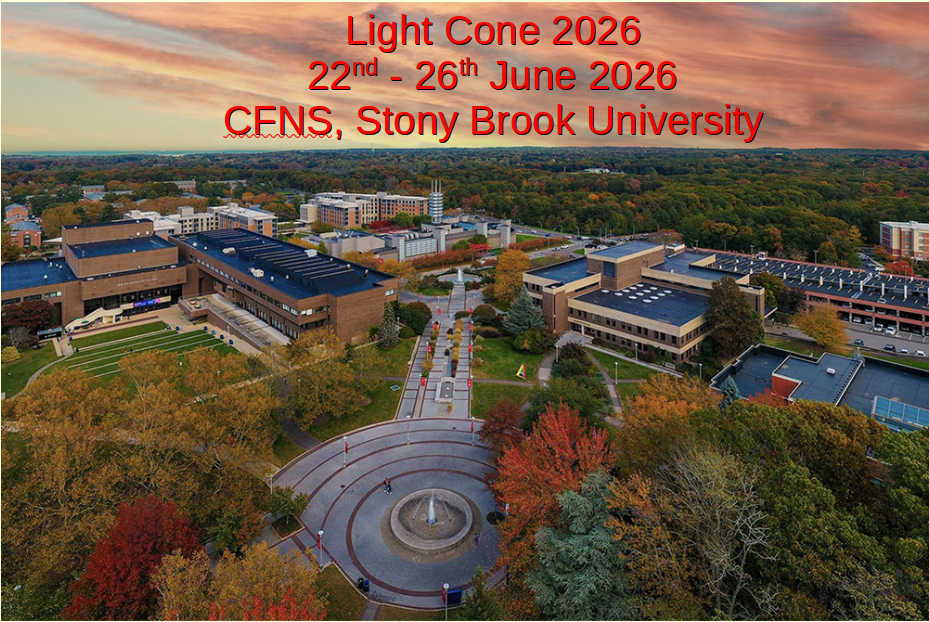
Light-Cone 2026: Applications at EIC era (LC2026) is scheduled to take place from June 22 to 26, 2026 at the Center for Frontiers in Nuclear Science, Stony Brook University, NY, USA.
https://www.stonybrook.edu/cfns/
Registration open: Nov 14, 2025
Early-bird Registration deadline: Apr 15, 2026
Abstract submission open: Nov 15, 2025
Abstract submission deadline: Apr 10, 2026
Light-Cone 2026 continues the conference series that began in 1991, overseen by the International Light Cone Advisory Committee (ILCAC). For the information on past Light Cone conferences, please refer to the ILCAC website (http://www.ilcacinc.org/past-meetings). These conferences have been crucial for advancing our understanding of quantum field theory, quantum chromodynamics (QCD), and high-energy physics. Over time, they also evolved into a platform for exploring developments in hadron and nuclear physics, with a focus on several experimental facilities including upcoming EICs. These conferences serve as a hub where scientists come together to exchange ideas, cooperate on research, and keep pushing the boundaries of our knowledge about the smallest building blocks of the universe.
The previous conference on “Light-Cone 2024: Hadron Physics in the EIC era” held in Huizhou, China (https://indico.impcas.ac.cn/event/55/) emphasized to design a scientific program that will inspire advancements in the leading edge of research in nuclear, hadron, and particle physics at Electron-Ion Colliders (EICs).
Light-Cone 2026 also in the EIC era, will focus on the following theoretical/experimental tools to study light cone QCD with emphasis on their applications at the EIC:
Topics:
The early bird registration fee for students is USD 150 and for the rest the early bird registration fee is USD 300. After early bird registration deadline, an extra USD 50 will be charged for registration.
We look forward to welcoming you in Stony Brook in June 2026 !
We review recent progress in Hamiltonian Light-Front quantization of QCD within a basis function representation known as BLFQ. Expanded Fock spaces are employed to include dynamical gluons and sea quark-antiquark pairs. Observables such as mass spectra, parton distribution functions (PDFs), electromagnetic form factors and transitions, among others, are calculated and compared with experiment where available as well as with other theoretical approaches. Good agreement with experiment is obtained in many cases and residual discrepancies point to a need for larger basis spaces. We also discuss recent progress in accounting for bosonic zero mode contributions within a scalar field theory application.
Basis Light-Front Quantization (BLFQ) is a fully relativistic and nonperturbative framework for solving the light-front QCD Hamiltonian, aiming at first-principles calculations of hadron structure.
For the nucleon system, we extend the Fock space up to six-particle sectors, including configurations such as five-quark–one-gluon and three-quark–three-gluon components with dynamical gluons. In our calculations, we implement the full light-front QCD Hamiltonian without introducing any effective interactions.
By fitting the nucleon and Λ mass spectra together with their electromagnetic form factors within a truncated basis space, we constrain the remaining model parameters. Diagonalization of the QCD Hamiltonian yields light-front wave functions that preserve the symmetry properties of fermions and gluons.
Using these wave functions, we compute physical observables such as gluon and sea-quark parton distribution functions (PDFs) at a low resolution scale. The resulting distributions are subsequently evolved to higher momentum scales via QCD evolution for direct comparison with experimental measurements.
Finally, we outline future prospects and ongoing developments of this framework.
The talk reviews two dosens of works during 2020's, with I.Zahed and students.
At the spectroscopy side we develop novel methods to derive wave functions
of multiquark hadrons with Fermi statistics,
based on representations of permutation groups Sn. Particularly
I will discuss pentaquarks and their admixture to nucleons, which are central to the
spin puzzle and antiquark PDFs. We also gradually developed hadronic spectroscopy on the
light cone, from mesons and baryons to tetra and pentaquarks.
We solve natural Hamiltonians using Jacobi coordinates, and get LC wave functions, from
which PDFs, GPDs and formfactors are consistently calculated. We argue that description
at resolution scale $\mu\sim 1 \, GeV$ is common, both from below by spectroscopic models
and from above by gluonic evolution.
Computational access to the logarithmically scale-dependent Hamiltonian eigenstate picture of hadrons in the space of virtual quark and gluon states, within the canonical front form of QCD, is impeded by small-x divergences that are stronger than logarithmic. We propose introducing a gluon mass parameter and an auxiliary color-octet scalar field to overcome this barrier, using the renormalization group procedure for effective particles (RGPEP) [1]. At the end of the effective Hamiltonian computation, the gluon mass parameter is taken to zero and the auxiliary field decouples from the dynamics, as required in gauge theory. The same method also leads to the cancellation of quadratic ultraviolet transverse divergences in self-interactions. We explain how this approach works in virtual quark and gluon scattering amplitudes, as well as in Hamiltonian eigenvalue problems for bound states, with the discussion focusing on the case of heavy quarkonia [2]. Previously [3], it was suggested that QCD vacuum effects, such as those appearing in QCD sum rules [4] and those due to instantons [5], can manifest themselves in the effective dynamics through front-form counterterms to small-x singularities. We use our approach to advance the hypothesis that the corresponding effective interaction terms can instead emerge in finite renormalization-group evolution as the scale parameter is lowered toward Lambda_QCD in the RGPEP scheme.
[1] S. D. Glazek, https://doi.org/10.1140/epjs/s11734-026-02127-y
[2] K. Serafin et al., Phys.Rev.D 109, 016017 (2024)
[3] K. G. Wilson et al., Phys.Rev.D 49, 6720 (1994)
[4] M. Shifman, A. Vainshtein, I. Zakharov, Nucl.Phys.B 147, 385 (1979)
[5] E. Shuryak, I. Zahed, https://arxiv.org/abs/2601.15085
Hamiltonian truncation is a powerful non-perturbative method for quantum field theory, but its accuracy is generally limited by the influence of high-energy states excluded from the truncated Hilbert space. I will present Hamiltonian Truncation Effective Theory (HTET), which addresses this issue by interpreting the truncation scale as an effective field theory cutoff and encoding the effects of the discarded states into an effective Hamiltonian acting within the truncated space. The two-dimensional $\lambda \phi^4$ theory provides a useful benchmark for this framework, where HTET yields a systematic improvement in the computation of low-energy observables. Beyond leading order, the effective Hamiltonian develops a non-local structure. Ongoing work focuses on extending this framework to light-front Hamiltonian truncation, with the goal of constructing a direct and systematic HTET formulation in the light-front setting.
We will present results for the nucleon structure within light-front dynamics, adopting different interaction models. The framework is based on the solution of the Bethe-Salpeter equation projected onto the light-front for an effective interaction, as well as in 1+1 dimensions in ladder approximation, and is compared to previous calculations. Results for the parton distributions will be shown. Additionally, calculations for the time-like form factors will be presented based on a phenomenological model.
We present a self-consistent light-front quark model for the pion and kaon based on the Bakamjian--Thomas (BT) construction and study their electromagnetic form factors,
unpolarized T-even transverse-momentum-dependent distributions (TMDs), and collinear parton distribution functions (PDFs). A consistent implementation of the invariant
mass $M_0$ in both hadronic matrix elements and Lorentz structures enforces four-momentum conservation and yields current-component--independent observables.
The light-front zero-mode issue and its resolution in TMD and form factor calculations are also discussed. We further analyze the perturbative QCD evolution of the valence PDFs.
The total spin of a hadron is a complex manifestation of its partonic constituents, arising from both the helicity of quarks and gluons, as well as their orbital angular momenta (OAM). Elucidating this spin structure at the partonic level remains a fundamental challenge in hadron physics. Analogous to spin-orbit correlations in atomic and nuclear systems, the interplay between spin and OAM is also realizable in QCD, adding richer content to the intrinsic spin structure inside hadrons.
In this talk, we will explore spin–orbit correlations in heavy mesons within the framework of light-front dynamics. We begin with a quantum many-body definition and explain its connection to the partonic interpretation. The equivalence between this definition and the expression derived from the parity-odd (P-odd) energy–momentum tensor (EMT) is shown in the valence quark Fock sector. To account for the effects of finite Fock-sector truncation, we analyze the hadron matrix elements of the P-odd EMT and find the relationship between its form factors and the spin–orbit correlation. Finally, we present our numerical results for these quantities in charmonium and the $B_c$ meson, based on light-front wave functions obtained via basis light-front quantization.
Relativistic quantum invariance plays prominent roles in the study of quantum field theories, typically QED and QCD. We utilize the idea of interpolating the instant form dynamics (IFD) and the light-front dynamics (LFD) to realize the relativistic quantum invariance of QED and QCD. Reviewing the connection between LFD and IFD using the idea of interpolating the two different forms of the relativistic dynamics, one can learn the distinguished features of each form and how one may utilize those distinguished features in solving the complicate relativistic quantum field theoretic problems more effectively. In this talk, I will present a mass gap solution of the 1+1D QCD in the large Nc limit known as the ‘tHooft model to discuss a link between QCD and the Light-Front Quark Model (LFQM) and highlight the utility of interpolation in the computation of the parton distribution function (PDF) for the study of hadron structures.
Light front densities have long been promoted as constituting true internal hadron densities. A big selling point is that light front uniquely permits transverse localization and a clean separation between the barycentric and internal degrees of freedom many-body systems, both of which follow from the light front's realization of the Poincaré group's Galilean subgroup. Rather than eliminating relativistic effects, the Galilean subgroup shuffles them into the longitudinal direction, ultimately introducing distortions into the light front densities. In this talk, I show that light front current and EMT densities inevitably retain artifacts of the barycentric wave packet.
The strong interaction is the fundamental force that holds quarks and the
gluon force carriers together to form protons and neutrons and also holds the
atomic nucleus together. The theory governing quark-gluon interactions is Quantum Chromodynamics (QCD). A wide variety of experimental data teaches us thatquarks and gluons cannot be observed in isolation, a phenomenon known as confinement that is unique to QCD. But no one has used QCD to prove confinement. Here we show how to define and measure the force on quarks in the proton using available experimental data. Direct evidence for confinement is obtained because the force is found to be attractive and constant for a wide range of quark positions. This work guides future experimental efforts aimed at obtaining a rigorousquantitative understanding of confinement.
Based on soft collinear effective theory (SCET), we derive factorization formula for the so-called Feynman contribution to the generalized parton distributions (GPD) and gravitational form factors at large momentum transfer.
Based on https://arxiv.org/abs/2508.01529
Generalized transverse-momentum dependent distributions (GTMDs) provide the most differential two-parton correlators for hadronic phase-space tomography, while GPDs and TMDs arise as limiting or projected descriptions relevant to exclusive, diffractive, and transverse-momentum-sensitive measurements in the EIC era. I will describe a fixed-conformal-spin holographic framework in which this hierarchy is realized geometrically through string exchange in confining AdS backgrounds. The starting point is the fixed-spin channel of the GPD problem: conformal moments diagonalize the exchanged spin, make polynomiality in skewness manifest, and represent the all-skewness nucleon GPDs through spin-dependent form factors generated by t-channel string exchange. This construction is further constrained by a fixed-scale matching of holographic current-current correlators to QCD, where the ultraviolet photon/current vertex reproduces the conformal-OPE Wilson-coefficient structure at a single matching scale, while the infrared sensitivity is isolated in hadronic conformal moments. The new ingredient is the extension to gluon GTMDs at finite transverse separation b⊥. The gauge-invariant bilocal gluon operator, including its staple-shaped Wilson line, is represented by a classical string worldsheet attached to the same fixed-spin exchange that controls the GPD conformal moments. At leading order in the large-Nc and large-coupling semiclassical expansion, this gives a factorized description: a universal worldsheet soft factor encodes the strong coupling analogue of Collins–Soper rapidity evolution, while a stripped bulk exchange amplitude carries the hadronic dependence on skewness, momentum transfer, and confinement. The resulting impact-parameter representation connects the ultraviolet endpoint to the boundary GPD conformal moment and gives controlled predictions for nonperturbative transverse structure, including an algebraic soft-wall tail and, in a mixed hard-wall infrared limit with a massive transfer, a confining exponential falloff at large b⊥. Analytic continuation in conformal spin then reorganizes the same fixed-spin amplitudes into the low-x Regge regime, in direct analogy with the BPST Pomeron, without adding new non-perturbative input. In this sense, the phrase “strings attached” is literal: the GTMD is obtained by attaching the Wilson-line worldsheet to the fixed-spin string exchange that already controls the GPD sector.
Transverse-Momentum dependent Distributions (TMDs) are a key tool to build a 3-Dim tomography of the Nucleon in momentum space. I will discuss some recent TMD extractions for quarks in the Nucleon, whose analyses are reaching a theoretical precision comparable to collinear Parton Distribution Functions (PDFs), and I will show the potential impact of the upcoming Electron-Ion Collider (EIC). If time is sufficient, I will sketch also possible EIC channels to extract the almost unknown gluon TMDs, and I will discuss a recent spectator model calculation of them.
We present a detailed study of the TMD evolution effects on the Sivers asymmetry in an almost back-to-back production of J/psi and photon as well as J/psi and jet at the electron-ion collider(EIC). We discuss the effect of the perturbative as well as the non-perturbative evolution kernels.
Potential experimental signatures of generalized transverse momentum-dependent distributions (GTMDs) are proposed through exclusive pseudoscalar and heavy (axial-)vector meson production in lepton-proton collisions. Within the framework of collinear twist-3 factorization, we show that specific azimuthal-angle-dependent observables are sensitive to the quark and gluon GTMDs $F_{1,4}$ and $G_{1,1}$, which are directly connected to partonic orbital angular momentum and spin-orbit correlations, respectively. These distributions probe a unique sector of nucleon structure and have no counterparts within the generalized parton distribution or transverse-momentum-dependent frameworks. We point out that sin2ϕ and cos2ϕ modulations provide clear experimental signatures of these otherwise elusive GTMDs, thereby opening a new avenue for accessing the spin structure of the nucleon.
The near-threshold photo- and electroproduction of heavy vector quarkonia off the proton offers a unique probe of its gluonic structure. In particular, the $J/\psi$ photoproduction cross section close to threshold is directly sensitive to the proton’s gluon gravitational form factors (GFFs). In this work, we employ the generalized parton distribution framework, combined with gluon GFFs computed in a light-front gluon-spectator model inspired by soft-wall AdS/QCD, to predict the differential and total cross sections for near-threshold $J/\psi$ and $\Upsilon$ photoproduction. I will present our results and compare them with measurements from the $J/\psi$-007 experiment and the GlueX Collaboration at Jefferson Lab.
The upcoming Electron-Ion Collider requires a high level of theoretical precision to fully map the spin structure of the nucleon. A critical component of this precision is the rigorous treatment of heavy-flavor contributions to polarized deep inelastic scattering. In this study, we explore the heavy quark impact on the polarized structure functions $g_1, g_4, g_5, g_6,$ and $g_7$ at next-to-leading order. Our calculations are performed within the ACOT renormalization scheme, ensuring theoretical consistency across the kinematic transition where heavy quarks shift from being dynamically produced to behaving as active degrees of freedom. We present the analytical results for these NLO contributions alongside their numerical implementation. These findings offer deeper insights into the role of heavy flavors in spin-dependent QCD dynamics and provide a necessary framework for the accurate extraction of polarized parton distributions in the EIC era.
In this talk, I will present a charge correlation observable in deep-inelastic scattering, defined as the charge deposit measured at a fixed polar angle relative to the incoming proton. Using soft-collinear effective theory, we derive factorization theorems for both the target and current fragmentation regions. In the forward limit, the nucleon charge correlator encodes detailed nucleon structure, while in the back-to-back limit the observable reduces to standard TMD factorization. This provides a natural extension of nucleon energy correlators to the study of charge flow.
We extend the asymmetric frame formalism for Generalized Parton Distributions (GPDs) to nonzero skewness by incorporating longitudinal momentum transfer. This framework, based on Lorentz-invariant amplitudes, provides efficient access to broad kinematics for mapping GPDs from the lattice. We validate the formalism using lattice data, extracting coordinate-space amplitudes to determine GPDs H and E, followed by quasi-distribution reconstruction and matching to the light cone. Additionally, we present an analysis of Mellin moments using neural network parameterizations to fit lattice data. This approach incorporates Next-to-Leading Order matching and renormalization group resumation evolution to obtain the final results. The principal challenges for nonzero skewness GPDs are also identified and discussed.
Chiral symmetry breaking by instantons converts low-energy QCD into an effective dynamics of massive fermions with chiral spin-flavor interactions. The same mechanism converts QCD operators with gauge fields into effective multifermion operators. Large instanton effects are observed in the twist-3 part of the QCD quark energy-momentum tensor [1], which controls the decomposition of the quark angular momentum in spin and orbital parts. We compute the instanton effect on the flavor-nonsinglet quark angular momenta $S_{u-d} + L_{u-d} = J_{u-d}$ and show that the large negative $L_{u-d}$ partly cancels the positive $S_{u-d}$ in the spin sum rule [2]. We discuss the mechanical interpretation of the instanton-induced orbital angular momentum in the mean-field picture of the nucleon in the large-$N_c$ limit. We also study the instanton effects in spin-orbit correlations governed by the parity-odd analog of the energy-momentum tensor [3].
[1] J.-Y. Kim, C. Weiss, Phys. Lett. B 848 (2024) 138387
[2] J.-Y. Kim, H.-Y. Won, C. Weiss, to appear (2026)
[3] J.-Y. Kim, H.-Y. Won, H.-C. Kim, C. Weiss, Phys. Rev. D 110, 054026 (2024)
Light-front dynamics provides a natural framework for describing hadron structure in terms of partonic degrees of freedom, yet the role of the QCD vacuum remains subtle. In instanton liquid vacuum, nonlocal, momentum-dependent interactions for light quarks emerge from semiclassical gauge configurations in Euclidean space. By analytical continuation back to lightcone signature, we connects vacuum-induced covariant wave functions using Bethe-Salpeter-Faddeev resummation to light-front parton wave functions. We further compute key light-front observables, including distribution amplitudes (DAs), parton distribution functions (PDFs), and transverse momentum dependent distributions (TMDs) for light mesons and nucleons, incorporating both renormalization group and Collins–Soper evolution. The results show good agreement with experimental data and lattice QCD. Overall, this work provides a clean picture in which light-front hadron structure emerges from QCD vacuum topology, bridging nonperturbative vacuum physics with measurable partonic observables.
I will present the full second-order effective Hamiltonian of QCD, computed and renormalized using the renormalization group procedure for effective particles (RGPEP) and the canonical Hamiltonian as the starting point. The infrared singularities are regulated by a small gluon mass, and the final Hamiltonian is obtained in the limit of that mass approaching zero. We show that the matrix elements of the effective Hamiltonian between color singlet states are well defined in that limit, while nonsinglet states lead to logarithmically diverging matrix elements. This statement can be made for the entire Fock space because an interplay between mass terms and one gluon exchange terms in the Hamiltonian generates a Casimir operator multiplied by the logarithm of the regulating gluon mass. Therefore, the computed Hamiltonian forms a sound basis for numerical computations using either classical or quantum computers.
Additionally, I propose a new way of interpreting the zero-mode problem as a problem of finding self-adjoint extensions of the effective Hamiltonian, which is only defined as a symmetric operator or a symmetric form.
We present a new approach to light-front nuclear structure based on chiral EFT dynamics. It is intended for analyzing the low-energy nuclear structure at fixed light-front time, as it would be sampled in high-energy scattering processes on the nucleus. The elements of light-front nuclear structure in nucleon and pion degrees of freedom (configurations, propagation, interactions) are formulated using EFT concepts (hierarchy of scales, power counting).
As an example we consider the deuteron and compute the nuclear pion density. The deuteron is described by a light-front bound-state equation derived from the leading-order chiral interaction, with one-pion exchange providing the long-range force and contact terms encoding short-distance physics. On this basis, we construct the light-front pion density operator and evaluate its matrix elements in the deuteron.
The formulation consistently incorporates nucleon and pion degrees of freedom while preserving the light-front momentum sum rule order by order in the EFT expansion. This makes it possible to study how the pion distribution depends on the nucleon configuration in the bound state. The resulting pion density provides a controlled basis for investigating nuclear antiquark enhancement and antishadowing in light nuclei, and for connecting chiral nuclear dynamics with future EIC measurements.
The Unruh effect is a widely accepted expectation that the virtual particles of the Instant-Form vacuum appear to an accelerated observer as a gas of real particles at a temperature proportional to the acceleration. In this talk, we will show that the effect is absent in a Front-Form analysis, therefore questioning its objective existence, and how the Front-Form and Instant-Form conclusions may be reconciled.
Light-cone Perturbation theory in coordinate space for massless particles has many of the nice features of its momentum space analog and also important differences. The role of states in momentum space is taken by paths in the coordinate version. We'll summarize coordinate diagrammatic rules and discuss progress toward understanding how infrared divergences cancel in the coordinate picture.
In spectator tagged DIS on nuclei, products of nuclear breakup are detected. This is an example of SIDIS in the target fragmentation region. Methods of light-front quantization are employed to separate nuclear and nucleonic structure in the high-energy process and achieve a composite description.
The light-front wave function of the polarized deuteron is matched with a rotationally covariant 3-dimensional wave function in the center-of-mass frame of the $NN$ system. The polarized tagged cross section is computed in the impulse approximation. The effective polarization of the active nucleon is determined by the deuteron polarization and the detected spectator momentum ($S/D$ wave ratio).
Predictions for polarization observables (various vector & tensor asymmetries) are given, and their dependence on the nuclear structure model is studied. Measurements of these tagged observables are especially suited for colliders with far-forward detectors and could be performed at the EIC with an accelerator upgrade that allows for polarized deuterons.
We present a new derivation of the non-linear evolution equations for the cross sections of productions of $n$-cut Balitsky-Fadin-Kuraev-Lipatov (BFKL) Pomerons in the final states ($\sigma_n$) in high energy DIS on a nucleus, resumming all multiple rescatterings and all leading logarithms of energy. These equations coincide with the equations that have been derived using the Abramovsky, Gribov and Kancheli (AGK) cutting rules but based on the dipole approach to high energy QCD. In the second part of the talk we discuss approximate analytical solutions for the equations in the small-$n$ and large-$n$ approaches. Using the analytical solution for $\sigma_n$ at large $n$ we calculate the multiplicity distribution of produced gluons, their probability to be observed and the entropy of the produced gluons at large values of the geometric scaling variable $z=\ln(r^2 Q_s^2)$.
We derive the gluon transverse-momentum-dependent (TMD) operator structure of back-to-back quark–antiquark dijet production in deep inelastic scattering at arbitrary Bjorken-x to twist-3 accuracy. Working in back-to-back kinematics, where the transverse momentum imbalance is much smaller than the individual jet momenta, we perform a systematic gradient expansion of quark propagators in the gluon background, organized in terms of longitudinal Wilson lines and field strength tensors. This approach yields results at general Bjorken-$x$, extending beyond the eikonal approximation. We present explicit cross sections for both longitudinally and transversely polarized virtual photons, including leading-twist gluon TMDs and subleading contributions from $F_{+-}$, $F_{ij}$, and three-gluon correlators. In the small-$x$ limit, our expressions reproduce existing Color Glass Condensate results at sub-eikonal accuracy. We further reduce the operator basis using equations of motion, minimizing the number of independent nonperturbative structures. This work provides a systematic foundation for extending TMD analyses of dijet production beyond leading twist, establishing a unified operator framework valid at arbitrary Bjorken-x that smoothly interpolates between moderate- and small-x descriptions of gluon TMDs.
Within the Color Glass Condensate (CGC) framework and using the light cone wave function (LCWF) formalism, we compute the differential cross section for single inclusive gluon production at central rapidity at next-to-leading order (NLO) in the small-$x$ regime. In the CGC approach, the LCWF factorizes into valence and soft sectors residing in separate Hilbert spaces, separated by an arbitrary momentum scale. The dependence on this separation scale generates a renormalization group equation that defines the high energy evolution operator $\Omega$, which constructs the soft gluon dressing the valence degrees of freedom. The explicit structure of $\Omega$ beyond leading order is not known in closed form. In this work, we derive $\Omega$ at NLO using light cone perturbation theory through a systematic normal ordered operator expansion and construct its action on the valence Hilbert space to the accuracy required for the NLO cross section, including the necessary NNLO components. Using this operator, we diagonalize the QCD light cone Hamiltonian to the corresponding order and obtain corrections to the energy eigenvalues. The operator is fixed by matching to perturbative results and imposing unitarity. With the resulting evolution operator, we compute the single inclusive gluon production cross section and identify the contributions associated with final state interactions, running coupling corrections and small-$x$ evolution effects. This work provides a consistent operator level formulation of NLO gluon production at central rapidity within the LCWF framework.
Gravitational form factors (GFFs) are fundamental tools for probing the internal mass distribution and the dynamics of quarks and gluons within the hadron. They are derived from matrix elements of the energy–momentum tensor and encode information about the momentum, pressure, and energy distributions within hadrons. While lattice QCD offers robust results in Euclidean space, continuum methods like Dyson–Schwinger (DSE) and Bethe–Salpeter (BS) equations formulated directly in Minkowski space allow direct access to real-time observables and infrared dynamics—particularly those relevant for gluonic contributions .
This study focuses on computing the pion’s GFFs using Minkowski-space BS amplitudes and DSE solutions with dressed quarks and gluons. Simple analytical models constrained by lattice QCD results on dressed quarks, gluons and quark-gluon vertex will be used to describe the pion GFFs, with special emphasis on the separation of quark and gluon contributions.
I discuss progress on the application of the clothed-particle representation of
quantum field theory, originally due to Greenberg and Schewber [1] and devel-
oped by O. Shebeko and collaborators [2][3][4], to compute relativistic electron
and neutrino scattering observables off of light nuclei. In this application a
canonical transformation is applied to the Poincaré generators and strong cur-
rents of a local quantum field theory with meson-exchange interactions to con-
struct a new representation of the theory, where the transformed vacuum and
one-particle states are exact eigenstates of the transformed Hamiltonian. The
canonical transformation eliminates all meson-nucleon vertices. The simplest
interaction in the clothed particle representation is a non-local two-body inter-
action. The interaction depends on the original renormalized parameters of the
field theory, which are adjusted to give a realistic description of the two-nucleon
system. The same canonical transformation gives a new representation of the
Poincaré Lie algebra and consistent few-body currents which are used in the
one photon (W,Z) exchange approximation. Preliminary results are presented.
This research supported by NSF IMPRESS-U Award ID 2427848∗ , the Na-
tional Science Centre, Poland, under Grant No. IMPRESS-U 2024/06/Y/ST2/00135∗∗
and in part by the Excellence Initiative– Research University Program at the
Jagiellonian University in Kraków, the National Academy of Sciences (USA)
and the Office of Naval Research Global (USA) in assistance of the Science and
Technology Center in Ukraine (Grant No. 7134) ∗∗∗ , and the Japanese Society
for the Promotion of Science (JSPS) under Grant No. JP25K07301 ∗∗∗∗ The nu-
merical calculations were partly performed on the supercomputers of the Jülich
Supercomputing Center (JSC), Jülich, Germany.∗∗ .
[1] O. W. Greenberg and S. S. Schweber, Il Nuovo Cimento, VIII (1958) 378-406.
[2]A. V. Shebeko and M. I. Shirokov, Progress in Particle and Nuclear Physics
Volume 44, March 2000, Pages 75-86.
[3] Kostylenko, Y., Shebeko, O., Few-Body Syst 65, 55 (2024).
[4] Dubovyk, I., Shebeko, O., Few-Body Syst 48, 109–142 (2010).
[5] Kamada, H., Shebeko, O., Arslanaliev, A., Few-Body Syst 58, 70 (2017).
I will discuss recent lattice results on unpolarized, helicity and transversity PDF obtained with LaMET framework with HYP smeared clover Wilson quarks in valance sector and highly improved staggered quarks in the sea with lattice spacing a=0.076 fm and 0.06 fm. The lattice results will be compared to the ones obtained from global analysis and the effects of power law (higher twist) correction will be discussed.
Proton and neutron electric and magnetic form factors are the primary characteristics of their spatial structure and have been studied extensively over the past half-century. At large values of the momentum transfer $Q^2$ they should reveal transition from nonperturbative to perturbative QCD dynamics and effects of quark orbital angular momenta and diquark correlations. Currently, these form factors are being measured at JLab at momentum transfer up to $Q^2=18$ GeV$^2$ for the proton and up to 14 GeV$^2$ for the neutron. We will report an updated calculation of these form factors using nonperturbative QCD on the lattice, including $G_E$ and $G_M$ nucleon form factors with momenta up to $Q^2=12$ GeV$^2$, pion masses down to the almost-physical $m_\pi$=170 MeV, several lattice spacings down to $a=0.073$ fm, and high $O(10^5)$ statistics. Specifically, we study the $G_E/G_M$ ratios, asymptotic behavior of the $F_2/F_1$ ratios, and flavor dependence of contributions to the form factors. We observe some qualitative agreement of our ab initio theory calculations with experiment. Comparison of our calculations and upcoming JLab experimental results will be an important test of nonperturbative QCD methods in the almost-perturbative regime.
Generalized Parton Distribution functions (GPDs) are off-diagonal light-cone matrix elements that encode the internal structure of hadrons in terms of quark and gluon degrees of freedom. In this work, we present the first nonperturbative study of quasi-GPDs in the massive Schwinger model, quantum electrodynamics in 1+1 dimensions (QED$_2$), within the Hamiltonian formulation of lattice field theory. Quasi-distributions are spatial correlation functions of boosted states, which approach the relevant light-cone distributions in the luminal limit. Using tensor networks, we prepare the first excited state in the strongly coupled regime and boost it to close to the light-cone on lattices of up to 400 lattice sites. We compute both quasi-parton distribution functions and, for the first time, quasi-GPDs, and study their convergence for increasingly boosted states. In addition, we perform analytic calculations of GPDs in the two-particle Fock-space approximation and in the Reggeized limit, providing qualitative benchmarks for the tensor network results. Our analysis establishes computational benchmarks for accessing partonic observables in low-dimensional gauge theories, offering a starting point for future extensions to higher dimensions, non-Abelian theories, and quantum simulations.
Using generalized parton distributions as a unifying framework, we interpret the connected and disconnected contributions obtained from the ab-initio Euclidean path-integral formulation of the hadronic tensor in the context of both nucleon elastic form factors and parton distribution functions. We also develop a phenomenological approach to characterize non-perturbative effects in deep-inelastic structure functions, which may be extended to heavy-ion observables probing baryon junctions.
Quantum simulation is a motivating application for large-scale quantum computers. Quantum simulation of quantum field theories involves challenges of regularization, renormalization and gauge symmetry. The light front provides a particularly appealing approach for quantum simulation, allowing techniques developed in other fields to be reused. I will give an introduction to our work in quantum simulation of the yukawa model and early results on QCD, and discuss the prospects for large-scale calculations in the future.
How does a far-from-equilibrium quantum system reach thermal equilibrium, and what role does entanglement play? We address these questions in the massive Schwinger model — a non-integrable (1+1)-dimensional gauge theory — subjected to a quench by a pair of charges receding at the speed of light. Using tensor network methods, we study the resulting string breaking dynamics, which serve as a direct analogue of jet fragmentation. In the aftermath of string breaking, we find thermal behavior confirmed by multiple independent temperature measures yielding a single consistent value. We further demonstrate that the entanglement entropy of the evolving state quantitatively matches the Gibbs entropy at this temperature, establishing a precise link between quantum entanglement and thermalization.
We present a hybrid computational framework for light-front Hamiltonian calculations in which machine learning is used to assist Fock-space truncation, while the low-lying spectrum is obtained from standard Hamiltonian diagonalization. The goal is to reduce the computational cost of non-perturbative light-front calculations without compromising the physical reliability of established numerical methods. As a proof of concept, we consider simplified light-front bound-state models and train a neural-network-based importance estimator to identify basis states that contribute most significantly to low-lying eigenstates. The selected reduced basis is then passed to a conventional diagonalization procedure, enabling direct comparison with results from larger reference truncations. This approach provides a controlled setting for studying the convergence of light-front spectra under machine-learning-guided basis selection. We discuss quantitative criteria for truncation error, computational efficiency, and the robustness of low-lying wave functions. The framework is intended as a first step toward more efficient light-front calculations relevant to hadron structure and parton physics in the EIC era.
Generalized Parton Distribution functions (GPDs) are off-diagonal light-cone matrix elements that encode the internal structure of hadrons in terms of quark and gluon degrees of freedom. We present the first nonperturbative study of quasi-GPDs in the massive Schwinger model, quantum electrodynamics in 1+1 dimensions (QED2), within the Hamiltonian formulation of lattice field theory. Quasi-distributions are spatial correlation functions of boosted states, which approach the relevant light-cone distributions in the luminal limit. Using tensor networks, we prepare the first excited state and boost it to close to the light-cone on lattices of up to 400 lattice sites. We compute both quasi-parton distribution functions and quasi-GPDs, and study their convergence for increasingly boosted states. Our analysis establishes computational benchmarks for accessing partonic observables in low-dimensional gauge theories, offering a starting point for future extensions to higher dimensions, non-Abelian theories, and quantum simulations.
Extending quantum simulations of lattice gauge theories beyond one spatial dimension requires encoding gauge fields with infinite-dimensional local Hilbert spaces. I will present a hybrid qubit-qumode framework for real-time simulations of quantum electrodynamics in (2+1) dimensions, where fermionic matter fields are encoded in qubits and gauge fields are represented by continuous-variable bosonic modes. This formulation provides a natural route toward simulating real-time gauge-field dynamics relevant for nuclear physics, including string breaking, particle production, and non-equilibrium phenomena. I will discuss how compact gauge dynamics can be implemented in this hybrid architecture and outline prospects for simulating Abelian and non-Abelian gauge theories coupled to fermionic matter on emerging quantum hardware platforms.
We propose a method for solving the Jalilian-Marian–Iancu–McLerran–Weigert–Leonidov–Kovner (JIMWLK) evolution equation on quantum computers. Our approach exploits the reformulation of the JIMWLK equation as a Lindblad master equation governing the rapidity evolution of the hadronic density matrix, as established in prior work. To render the problem tractable for quantum simulation, we introduce several approximations: the two-dimensional transverse plane is reduced to a one-dimensional radial lattice by assuming azimuthal symmetry of the jump operators; the gauge group is restricted to $\mathrm{SU}(2)$; and the infinite Wilson lines of the JIMWLK equation are replaced by finite Wilson links along the light-cone direction. The resulting bosonic Hilbert space is truncated using the electric field basis familiar from Hamiltonian lattice gauge theory, with states restricted to angular momenta $j\leq j_{\mathrm{max}}$. We derive the matrix elements of the JIMWLK Lindblad jump operators in this basis. As a benchmark, we demonstrate rapid convergence of the fundamental dipole expectation value with $j_{\mathrm{max}}$ for both pure and mixed Gaussian initial density matrices. For the simplest truncation, $j_{\mathrm{max}} = 1/2$, we implement the Lindblad evolution
using a quantum simulation algorithm verified with the Qiskit statevector simulator by decomposing the non-unitary evolution operator into a linear combination of unitaries. This work establishes a concrete pathway toward quantum simulation of high-energy QCD evolution equations, with direct relevance to the physics program of the Electron-Ion Collider.
Angular momentum (AM) contains explicit position vectors, and its definition depends on the choice of pivot. The corresponding internal AM operators defined relative to the relativistic centers of energy, mass, and spin, as well as their transverse spin sum rules, have been studied previously. We extend this discussion to spatial distributions in the nucleon. We derive the two-dimensional distributions in the transverse plane by integrating the corresponding three-dimensional spatial distributions over the longitudinal coordinate within the quantum phase-space formalism. We analyze their multipole structures and investigate how the transverse distortions evolve with the longitudinal nucleon momentum $P_{z}$. We further perform the same analysis in the light-front (LF) formalism with respect to the center of LF momentum. We propose an interpolation relation between instant-form and \ac{LF} spatial distributions, showing that the two formalisms consistently match in the infinite-momentum frame.
We report updates on tackling the systematics in the nucleon gluon parton distribution function (PDF) from Large-Momentum Effective Theory (LaMET). We compute use the self renormalization technique to compute gluon PDFs from data measured on HISQ ensembles generated by the MILC collaboration with $N_f = 2 + 1 + 1$, $a = 0.15, 0.12, 0.09$ fm, with valence pion masses around 310 and 690 MeV. We find slight dependence on the lattice spacing, which is fully controlled by a continuum extrapolation. We study pion mass and gauge link smearing effects, finding minimal dependence in both cases. Overall, we find a gluon PDF which prefers fewer gluons at large-x, which could provide strong constraints on global fits of the gluon PDF.
We also report on preliminary results towards computing the gluon PDF from Coulomb gauge fixed correlators.
The deuteron, as the lightest nuclear bound state, provides a unique laboratory for investigating the transition from conventional nuclear degrees of freedom to quark-gluon dynamics in nuclei. In this work, we explore QCD effects in the deuteron beyond the traditional proton-neutron description by incorporating hidden-color configurations within a light-front framework. Using a separation-of-variables approach, transverse confinement is modeled through light-front holography, while longitudinal dynamics are governed by the 't Hooft equation. This framework enables the investigation of the deuteron’s internal structure in terms of quark degrees of freedom and allows the calculation of electromagnetic form factors together with unpolarized, polarized, and tensor-polarized structure functions. We discuss the role of hidden-color correlations and their implications for the spin structure and partonic dynamics of the deuteron.
Complementarily, efforts are also underway within the basis light-front quantization framework to describe the deuteron directly at the partonic level through truncated six-quark and six-quark--one-gluon Fock sectors, providing further insight into its nonperturbative quark-gluon dynamics.
The doubly differential cross-section, both in photon energy and momentum transfer ($t$), for the near-threshold photoproduction of J/$\psi$ on the nucleon through its J/$\psi$ muon-decay channel, is compared to all available electron-decay channel data from Jefferson Lab, namely GlueX, CLAS12, J/$\psi$-007. Using those data together, I will show their impact on the extraction of the gluon gravitational form factors (GFFs) and using the QCD holographic model among others, and compare the results to lattice QCD. Furthermore, these EMT form factors are combined with the lattice EMT quark form factors and to evaluate the scalar and mass GFFs. The resulting scalar and mass energy density distribution in different frames, Breit and Drell-Yan frames will be shown. I will then discuss a resulting consequence, a comparison of the strong interaction size versus the electromagnetic size of the proton. I'll conclude my presentation with the impact of future detectors on those quantities, SoLID at Jefferson Lab for the J/$\psi$ near threshold production and ePIC at BNL for the near threshold $\Upsilon$ production at the EIC.